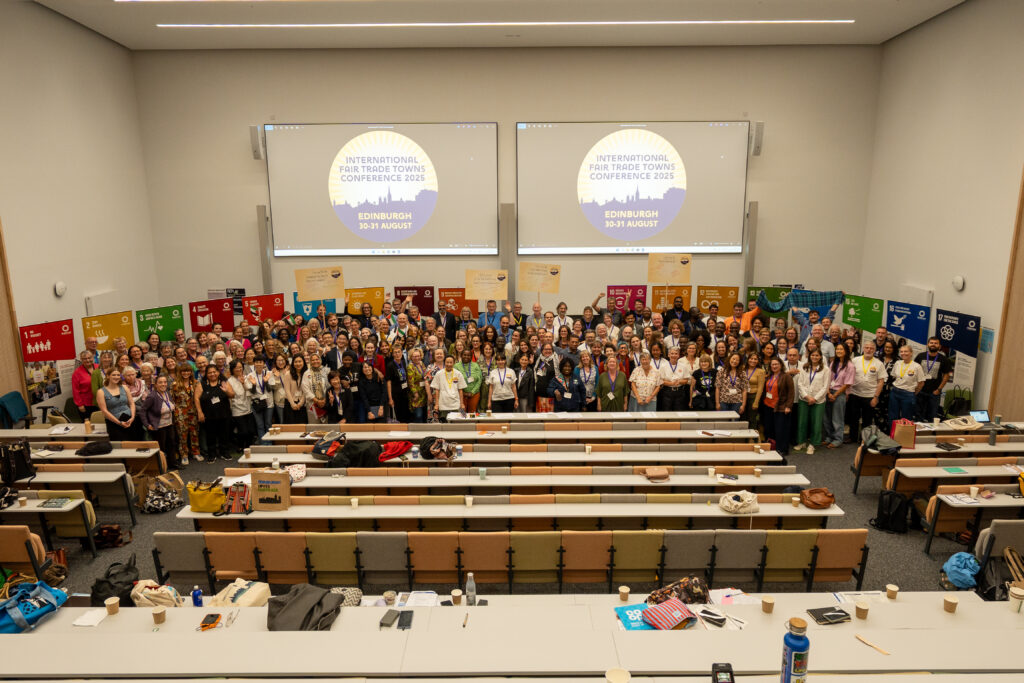
Over 250 delegates, from around the world, attended the 18th International Fair Trade Towns Conference in Edinburgh this weekend. People travelled from as far away as South Korea, Nepal, South Africa and Peru to attend it. The theme for the conference this year was “Your Town, Our World – Fair Trade Communities & Local Action to achieve the Sustainable Development Goals”. Once we started connecting with the attendees we created a lovely community of like minded people. A highlight was discovering that Paisley was twinned with Fürth in Germany and meeting their head of sustainability at the city council Philipp Abel.
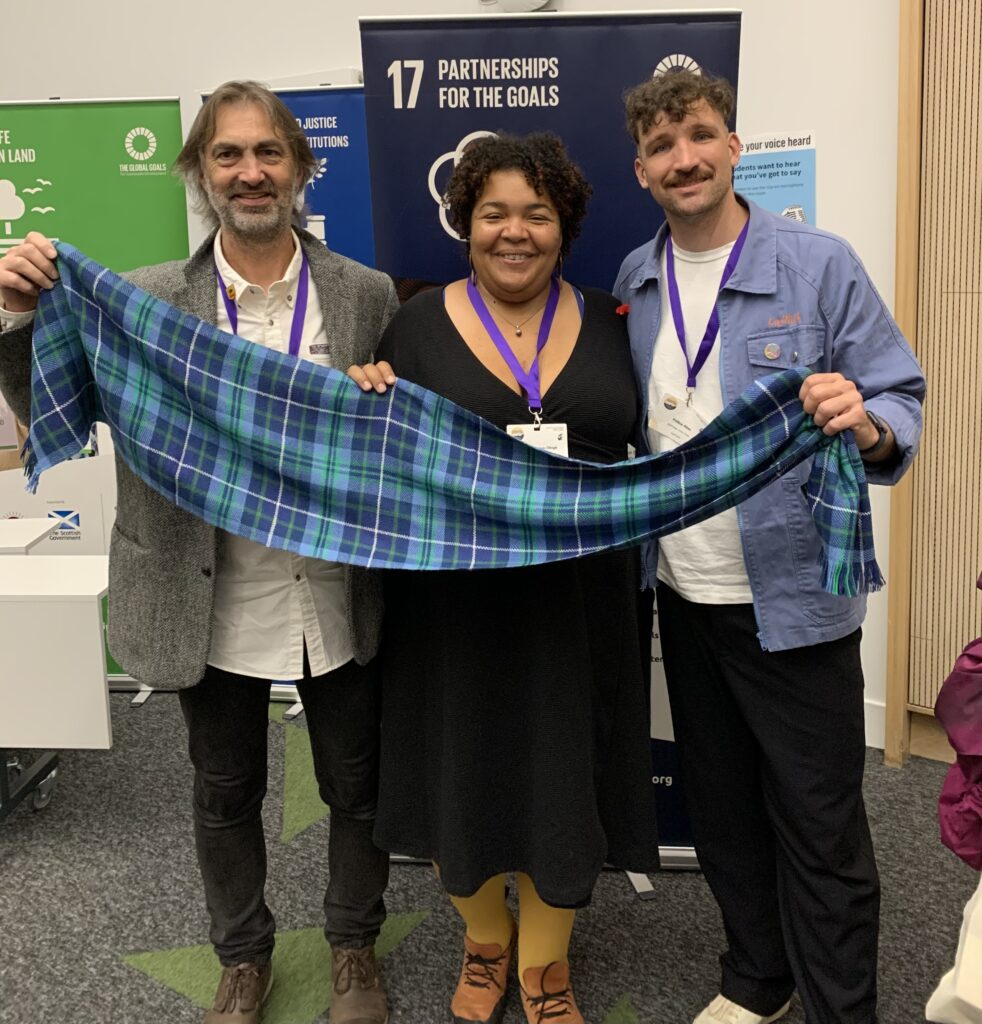
I enclose here a summary of what happened on the Saturday 31st August.
The conference opened Tabitha Nyariki, of Scottish Fair Trade, who said that dignity was at the centre of the movement. It was followed by Bruce Crowther, of The Fig Tree, and one of the founders of Garstang Fair Trade Group, talked about how they self-declared Garstang as the world’s first fair trade town. Other’s said, “you can’t do that”. He’s a great believer in going out and doing something even when others try to put you off.
The first panel asked the question: “What are the key challenges facing the movement right now?”
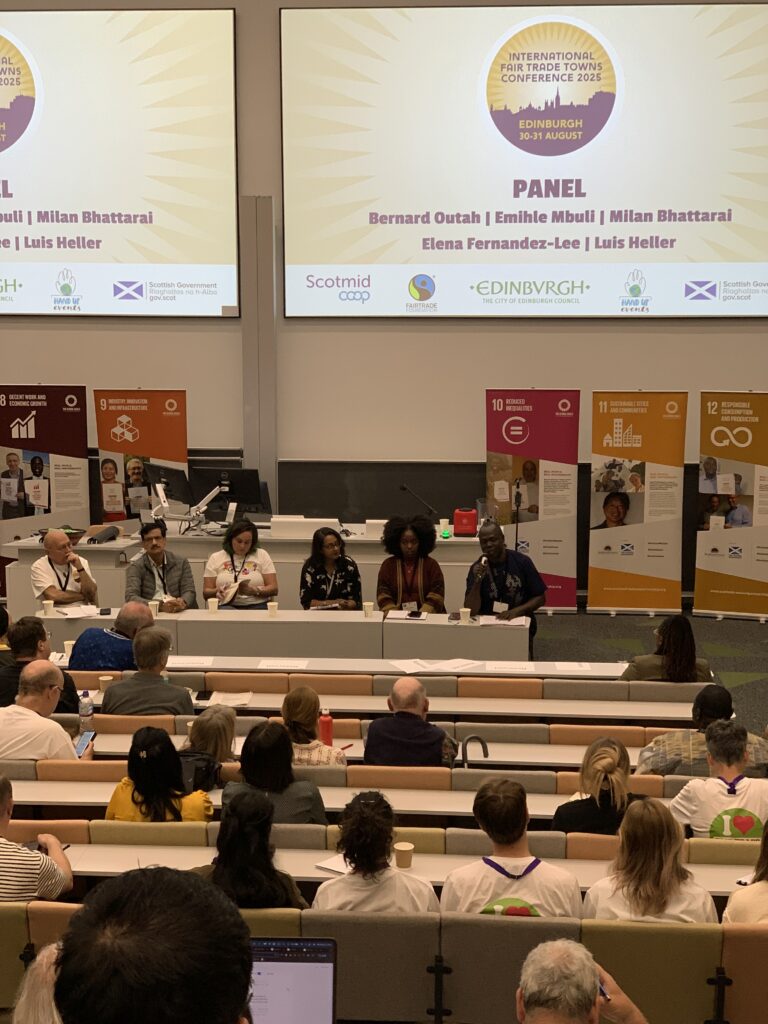
Bernard Outah, Regional Director of World Fair Trade Organization Africa, talked about:
- Being a fair trade country was not a badge but a call to action.
- There was a gap between producers and sellers.
- We have to influence global trade rules that aren’t fair.
- We need to see the movement grow south because there aren’t many fair trade countries in the global south.
- We should build on connections between north and south (which is exactly what was happening at the conference).
Emihle Mbuli, Young WFTO Africa Advocate, said:
- The youth is the base of the future.
- The youth is the bridge.
- The youth are caged due to inequalities and are looking for opportunities to make a difference.
- Fair trade can reduce youth unemployment, gender inequalities
Elena Fernandez-Lee, Education Campaigning Manager, Fairtrade Foundation, spoke about:
- There is a gap between youth in schools and unis with their communities
- The youth don’t trust institutions
- The young people are native digital campaigners
- We need to learn how to campaign with youth
- We have to appreciate that the youth obtain info in different ways
- Currently the far right dominates traditional communication methods. The young people don’t listen to those platforms.
- At the moment only 30% of population thinks that democracy works.
- Only 8% of population think that individual action works.
Milan Bhattarai, Director, Get Paper Industry, Nepal:
- Handmade paper manufacturer who started 30 years ago.
- They only use recycled paper and will not cut down trees to make it.
- Currently every tonne of paper comes from 17 trees being cut down.
- Every tonne of paper that they export they plant 17 trees.
- They train people in how to make paper and in leadership.
Luis Heller, Administration Manager, Allpa & Board Member, WFTO Latin America:
- We have to integrate communities to change situation
- We need to challenge to human rights and the economic situation
- We should break the ice between north & south
- Participation of people in the process is very important
The second panel was asked the question, “What is the role of Fair Trade in achieving the Sustainable Development Goals by 2030?”
Frances Guy, Chief Executive, Scotland’s Nucleus Building International Development Alliance:
- Fair trade not marketing itself enough, particularly in relation to the UN’s SDGs.
- We need to create a link between sustainable cities and FT towns.
- 35% of SDG targets are not on track for 2030.
- We need to tell stories more.
Christina Sotomayor – Hope (makes jewellery & crafts)
- Works with marginalised women, single mums, young students.
- Work in Lima shanty towns and Andean city towns.
- They provide flexible working opportunities for women.
- They work with Just Trade to sell their products in the UK.
- They work with partnerships across borders
- For many women it’s their first opportunity of a job
- They create opportunities to go into leadership roles
- They started in 2013 with 13 women working for them and now have 45 women.
Laura Cave – Just Trade
- Started as a jeweller and story teller and not a campaigner. Went to Peru and fell in love with the country. Founded Just Trade due to a friendship she made in Peru. The company is based upon 10 FT principles & WFTO member.
- She believes that you should campaign by doing things well and not just on the issue.
- They work with Hope, a woman’s artisan project in Peru. Hope created a cat toy based upon Hodge, a rescue cat at Southwark Cathedral, that had 25,000 followers on instagram. From that they now have developed a whole range of products around Hodge. It combines humour with something people can relate to.
- They’re now working with a high street retailer who are interested in their quality products and not because they’re fairly traded.
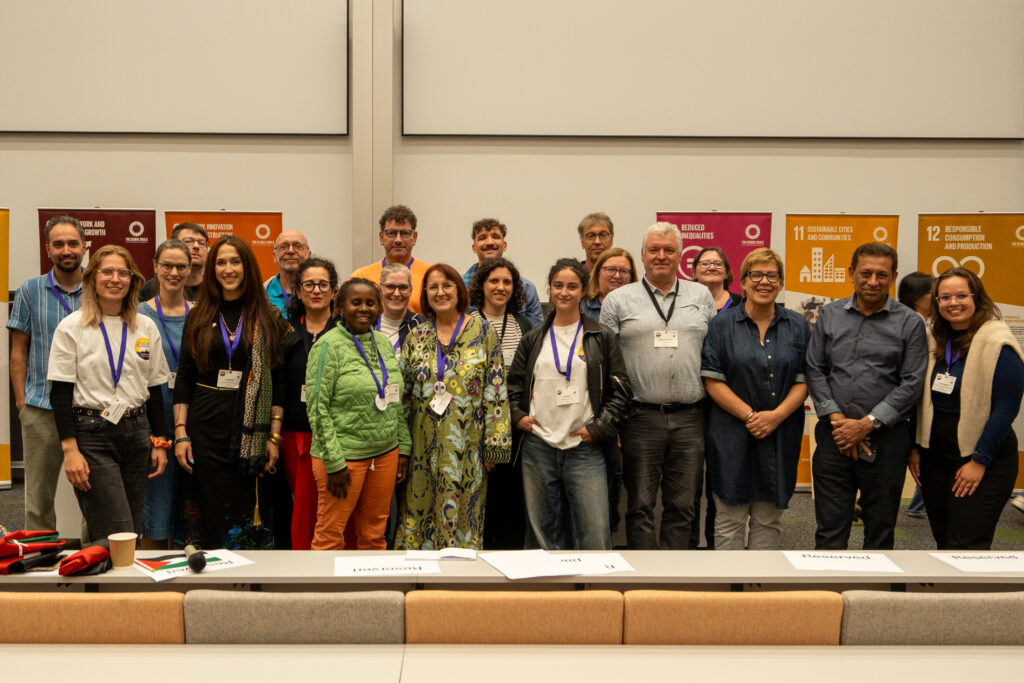
Lightning presentations – Fair Trade Towns Inspiration
Nicholas Apokerah, Fair Trade Towns Ghana (Bolgatanga)
- Bolgatanga is the capital of Ghana’s upper east region with a population of 132,000.
- Reknowned for its basket making, leatherwork, pottery and smock weaving.
- Traditions celebrated through festivals.
- Countryside recognised by red earth, baobab trees and warm Harmattan breeze.
- Good community spirit with its strong family connections, people working together and rich oral history.
- Traditional economical activities in agriculture, craft production, basket weaving, small holder trading and gold mining.
Daniela Cappelluti, FAIRkickt, Fairtrade Town Frankfurt
- During 2024 Frankfurt hosted 5 Euro 2024 football matches.
- The fair trade office wanted to use this opportunity to answer the question: How does Frankfurt sustainability issues and sport together, even beyond the four-week tournament?
- The answer was education and a space for creative solutions.
- They led 110 workshops, provided vegan lunches,
- And created 9 indoor and 1 outdoor accessible interactive spaces.
- They used an education video to teach about
- Inclusion & diversity
- Global Justice & Fair Trade
- Climate Protection
- Waste Reduction
- Over the 4 weeks they worked with
- 1200 young people between ages of 12 & 27
- 30 refugees
- 20 exchange students from Colombia
- 100 accompanying adults
- and 200 adults across the region.
Hyeonjin An, South Korea Fair Trade Towns Steering Committee
- Talked about their fair trade awareness campaign.
- They created the Incheon Fair Trade Youth Network with young people from universities and schools.
- Celebrated fair trade fortnight with a number of activities.
- Gwangmyeong City created fair trade gift sets to demonstrate their initiatives for sustainable fair trade.
- Incheon celebrated its fair trade festival with a fashion show, quiz and product exhibitions
Youth Engagement Inspiration
Alissa Hultman, Scottish Fair Trade Young Intern
- Talked about engaging young people.
- Said that Instagram & TikTok are the main platforms to interact with them on.
- Keep the message hopeful.
- Target those with an interest in sustainability and ethical production
- Comedy gets attention.
- Most young people want to choose FT but don’t know where to start.
- The content needs to be snappy, clear, informative and consistent.
- Trust is essential with the prevelance of misinformation and disinformation. They need a reliable source they can look to.
Merel Wulteputte, Fairtrade Youth Ambassador of Flanders, Faire Geminate
- Her interest in skateboarding led her to fair trade through someone bringing fair trade products to their skate park.
- She said that influencing young people can be like a stone thrown into the water. The stone disappears but the ripples can affect others.
- The young fair trade advocates engage with EU policy makers to influence fair trade and sustainability policies.
- Bring marginalised voices to the centre, especially young producers and artisans, through advocacy.
- Promote a fair and ecological future through campaigns, outreach and partnerships.
Evelina-Mihaela Ciobotaru & Giorgia Dal Fabbro, Young Fair Trade Advocates, Fair Trade Advocacy Office
- Foster dialogue between EU youth and young producers and artisans in Global South.
- Create videos for producers who don’t have the in-house skills.
- Run campaigns like #BiteSizedChange for fair and sustainable EU food systems.
- Host YFTAs round tables with activists, policy makers, NGOs and journalists.
- Draft and present policy recommendations by Global South voices.
- Represent young people at global events, like World Food Forum.
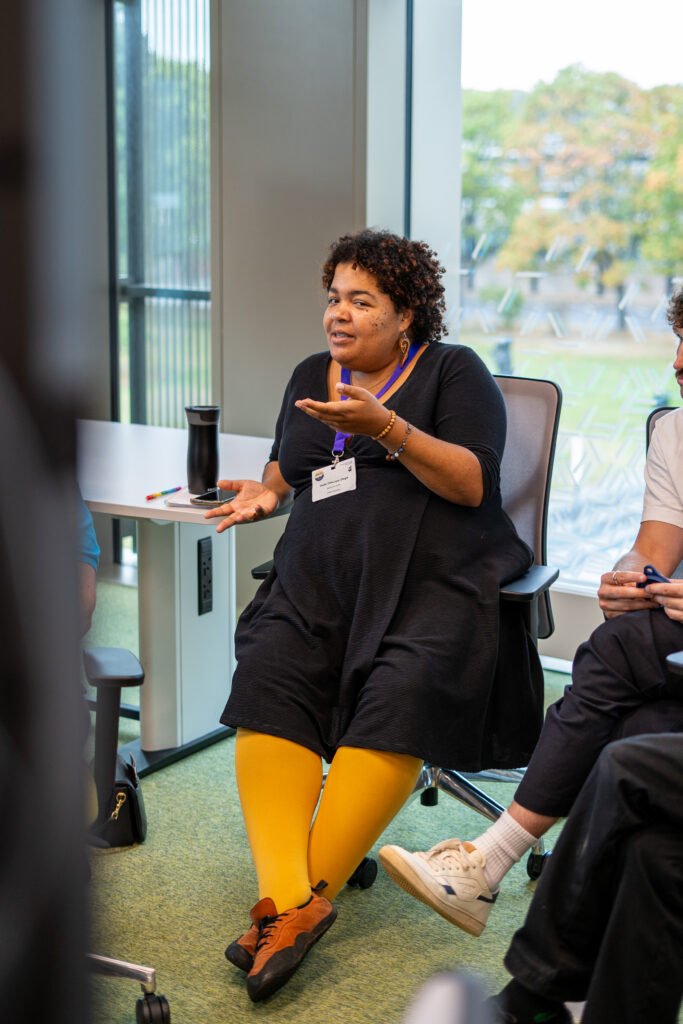
Panel: Structures and Systems to achieve the SDGs. How should campaigners engage with their elected representatives to achieve system change?
Martin Rhodes, MP for Glasgow North and Chair of All Party Parliamentary Group on Fairtrade
- Write to you elected representatives.
- Make it personal
- Gains further attention.
- Say something that is new/different
- Provide different statistics that they can use.
- Build relationships, use shared interests.
- Look for alliances/partnerships that amplify your message.
- SDGs came out of grassroots campaigns, academia, politicians.
- You have to keep the message positive.
- With the growth of far right, it’s still important to contact your MP.
- Sustainability and fair trade are often not the most important issues. Make them.
- Get a diverse group together, better than an individual.
Imogen Suett, Fairtrade Campaigner, Fairtrade Foundation
- Build networks.
- Can you be a platform for your elected representatives agendas?
- Help each other.
Magdalena Śliwińska, Associate Professor, Poznań University of Economics and Business
- Poznan became first economic FT university in Poland last year.
- FT and sustainable business markets and models go together.
- Fair trade campaigners have advanced discussions about sustainability.
- Societies based upon sustainability and care meet SDG goals
- FT does that already.
- “Everything you make, make sense”.
- Universities are trend setters for these ideas.
- Help them to obtain their FT accreditation.
Sagwata Manyike, Senior Advisor: Economic Growth and Investment, South African Local Government Association
- Advises other LGAs to help them become FT
- Draakenstein 1st self declared FT LGA.
- Repeat your message 7 times to your politician.
- Partnerships are key.
Wrap up
Talat Yaqoob, conference chair and member of the First Minister’s National Advisory Council on Women and Girls
- FT is a connected movement.
- Use FT to deliver SDGs.
- Enable youth engagement through digital platforms.
- FT delivers dignity, opportunity and justice.
